Low-Impact Dance Workouts for Small Apartments: No Jumping, Still a Real Workout
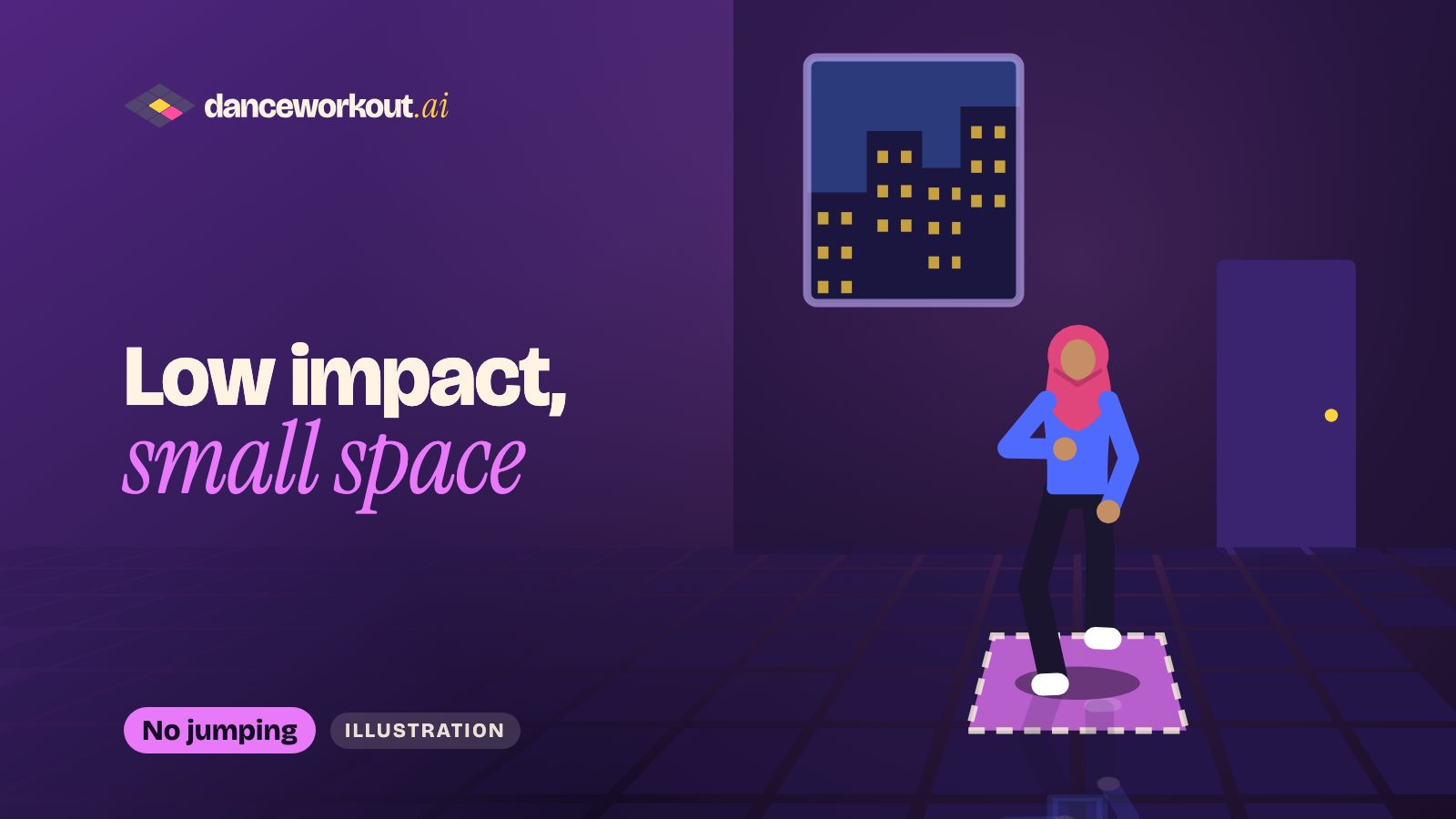
A low-impact dance workout keeps one foot on the floor at all times. No jumping means no landings thumping through the floor, and it is easier on your knees. You need about 6 by 6 feet of space and simple moves like step-touches, knee lifts and grapevines. Danced with energy, it is still a real workout.
This guide covers the space, the noise, your feet, ten quiet moves, and how to keep low impact challenging as you get fitter.
What does low impact mean in a dance workout?
Low impact means one foot always stays in contact with the floor. High impact means both feet leave the floor at once, as in a jump or a jumping jack. Most dance moves have a low-impact version: a jump becomes a quick rise onto your toes, a jumping jack becomes a step out to the side with the arms going up.
Low impact is not the easy option. The Compendium of Physical Activities, which researchers use to rate how much effort activities take, rates low-impact aerobic dance at a moderate effort as moderate-intensity activity. That is the kind the CDC asks adults to do for 150 minutes a week.
How much space do I need?
- Comfortable: about 6 by 6 feet, enough for a grapevine of two steps each way.
- Tight: the size of a yoga mat plus one step in every direction. Choose moves that stay in place: step-touches, knee lifts, marching, hip circles.
- Look up: check for ceiling fans and low lights before you reach your arms overhead.
- Clear the floor: move anything you could trip on, including rug edges that curl.
How do I keep a dance workout quiet for my neighbors?
- No jumping. This is most of it. Footfalls and jumps carry to the apartment below more than most people expect.
- Land softly. Step down through the ball of your foot to the heel, with soft knees, rather than stamping flat.
- Add a layer. A rug or a firm exercise mat absorbs sound. Avoid very soft, squishy mats for dancing: they make turns wobbly.
- Music in your ears. Headphones or earbuds keep the music in your ears and out of the floor. Keep the volume comfortable for your hearing, and keep any speaker low.
- Pick your time. Avoid early mornings and late nights, when noise is most noticeable and people are asleep.
- Say hello. A quick word with your downstairs neighbor, and a time they would prefer, saves a lot of worry.
What should I wear on my feet?
For most people, supportive sneakers. The American Academy of Orthopaedic Surgeons suggests a cross-training shoe if you do several kinds of exercise, trying shoes on at the end of the day (your feet swell during the day), and wearing the same kind of socks you will exercise in.
- Look for a shoe that bends at the ball of the foot and has a fairly smooth sole, so you can pivot. Deep running treads can grip too much for turns.
- Socks alone on wood, laminate or tile are slippery, and slips are easy there.
- Barefoot can work on a rug or a mat that grips, if it feels comfortable for your feet and joints.
Which dance moves are quiet and low impact?
| Move | How to do it | Make it harder |
|---|---|---|
| Step-touch | Step to the side, bring the other foot in to touch. Repeat the other way. | Bigger steps, arms reaching up and out |
| March | March in place, lifting your knees. | Higher knees, arms pumping |
| Knee lift | Lift one knee as high as is comfortable, lower it, switch. | Touch the opposite hand to the knee |
| Heel to back | Step to the side and kick one heel back toward your seat. | Pull your arms down as the heel comes up |
| Grapevine | Step to the side, cross behind, step to the side, tap. | Travel further, add a clap |
| Box step | Forward, forward, back, back, drawing a square. | Add a hip sway and arm rolls |
| Side reach | Step wide and reach your arm up and over to the other side. | Hold the reach for a beat |
| Squat and reach | Sit back into a comfortable squat, rise up and reach both arms high. | Squat a little deeper, if your knees are happy |
| Hip circles | Feet apart, draw slow circles with your hips, both directions. | Add a step in and out |
| Pivot turn | Step forward and turn on the ball of the foot. | Link two turns in a row |
How do I make low impact harder as I get fitter?
- Make the moves bigger: longer steps, arms overhead, deeper (comfortable) knee bends.
- Speed up a little, or slow down and hold each position for a beat, which is harder than it sounds.
- Keep moving between songs, so your effort never drops off.
- Dance longer blocks without a break.
- Use the talk test: if you can sing along easily, push the moves; if you can only manage a few words, ease off.
Who is low impact for?
Anyone who prefers it, and especially beginners, people with joint concerns, anyone who is pregnant or has recently had a baby (with their doctor’s OK), and anyone with pelvic-floor concerns. It is a full workout, not a lesser one. If you are pregnant, recently gave birth, or have a health condition, check with your doctor before starting.
Stop and get checked if you feel chest pain, dizziness, unusual shortness of breath, joint pain, or leaking or heaviness in the pelvic area.
New to dancing at home? Start with our beginner dance workout at home: a 15 minute plan built entirely from low-impact steps.
Dance at home, with your people
danceworkout.ai will have a low-impact version of every move, an AI coach, and friends who can dance alongside you, each in your own living room. See how it works as a quiet workout for apartments or a no-jump dance workout. We start together on January 1, 2027, with Dance Workout: Level 1, a 30-day dance workout of 15 minutes a day, and the app is free all of January. Join the waitlist to save your spot.
Questions people ask
Can a low-impact dance workout still be a good workout?
Yes. In the Compendium of Physical Activities, which researchers use to rate the effort of activities, low-impact aerobic dance at a moderate effort counts as moderate-intensity activity. That kind of activity counts toward the 150 minutes a week US guidelines recommend.
How do I dance in an apartment without disturbing my neighbors?
Keep one foot on the floor at all times, land softly by rolling through your foot, dance on a rug or a firm exercise mat, keep the music in headphones or at a low volume, and avoid early mornings and late nights. A friendly word with your downstairs neighbor helps too.
Should I dance barefoot or in sneakers at home?
Supportive sneakers are the safer choice for most people, especially on hard floors. Socks on wood or tile can slip. Barefoot can work on a surface that grips, if your feet and joints feel comfortable.
How much space do I need for a dance workout?
About 6 by 6 feet is comfortable. You can manage in the space of a yoga mat plus one step in every direction if you choose moves that stay in place.
Sources
Ready to start?
Join the waitlist and start Dance Workout: Level 1 with us on January 1, 2027 (30 days, 15 minutes a day). The app is free all of January.
Join the Waitlist